The Structural Transformation of the CRM Market through Artificial Intelligence
An Analysis of Market Consolidation and Evolving Corporate Processes
The integration of artificial intelligence (AI) into enterprise software has initiated a fundamental transformation of the Customer Relationship Management (CRM) market. This shift is not merely about sporadic functional enhancements, but alters the entire organizational, economic, and process-related structures on the part of both software vendors and adopting enterprises.
In the vendor landscape, this development is causing a historic paradigm shift: the established hierarchy of software giants is coming under pressure as traditional system architectures based on pure data storage are challenged by agile, AI-native platforms. While the acquisition, structuring, and manual maintenance of customer data were paramount over recent decades, the focus is now shifting toward automated processes, flexible system landscapes, and outcome-oriented business models. This article analyzes the profound structural changes in the development, market structure, integration methods, and implementation of CRM software.
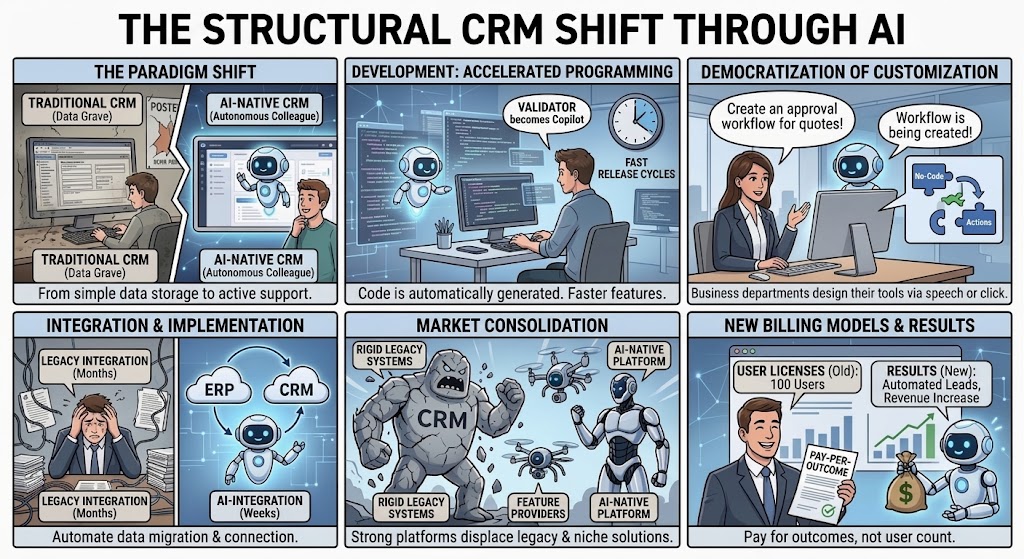
AI-generated illustrative image
1. Structural Changes among CRM Vendors
For developers and providers of CRM platforms, the arrival of artificial intelligence means a fundamental realignment of their core competencies. The way software is conceptualized, programmed, and further developed is undergoing a paradigm shift.
The Shift in Product Conception
In traditional software development, the conceptual design of a CRM system was based on defining data structures, input masks, and rigid user paths. Software architects had to precisely pre-determine how information would be linked and which clicks a user would need to perform to achieve a specific result. Only later did a few CRM vendors enable faster and more flexible workflow setups by integrating No-Code or Low-Code workflow designers.
Today, conception is shifting away from the user interface and toward process architecture. The system is no longer primarily designed as a passive database, but as an active support unit. For vendors, this means structurally reorganizing their development teams: the need for classic UI developers is decreasing, while the demand for experts in process modeling, data quality, and cross-system logic structures is rising.
The Fundamental Acceleration of Programming and Development
The cycles in which new software versions and industry-specific functions are brought to market have shortened drastically. This acceleration in development speed has clear structural causes:
- Automation of Code Generation: Developers use highly advanced assistant systems that automatically generate standard code building blocks, routine interfaces, and system documentation. This eliminates a large portion of time-consuming, repetitive manual work in the programming process.
- Shift in Competency Profiles: The task of software engineers is shifting from manually writing lines of code to architectural oversight and quality control. Less time is spent on the "how" of programming and more on the "what" of functional logic.
- Scalability of Updates: Because AI-backed systems react more flexibly to changes, vendors can roll out updates and functional enhancements at shorter intervals without jeopardizing the core stability of the system for customers. This leads to a continuous evolution of the software instead of high-risk major releases.
2. The Structural Upheaval in the Vendor Landscape: Market Consolidation
The technological disruption caused by AI will trigger a market shakeout among CRM providers. The balance between established major vendors and specialized niche players will shift fundamentally.
The Dilemma of Legacy Systems (Legacy Architectures)
Many established CRM vendors face the structural problem that their core systems are built on decades-old database structures. These systems were optimized for manual data entry, not for automated, context-based processing by algorithms.
- The Displacement of Rigid Systems: Providers who merely add AI features as superficial add-ons to an old architecture will lose competitiveness in the future. Customers quickly realize whether a system acts intelligently at its core or merely applies a cosmetic mask to existing, complicated processes.
- The Demise of Point Solutions: In the early years of the AI boom, numerous specialized add-ons emerged that offered, for example, only the automated creation of sales emails or the analysis of customer phone calls. These pure feature offerings are becoming increasingly obsolete as major CRM platforms integrate these functions natively into their core systems.
Consolidation and New Barriers to Entry
The market is concentrating on a few, highly technologically advanced platforms. Developing and operating powerful AI structures requires immense investment in computing power, data quality, and security infrastructures. Consequently, smaller CRM vendors who cannot make these investments will either disappear from the market or be acquired by larger consortia. At the same time, barriers to entry for new market participants are rising drastically: a new CRM system only stands a chance in the market today if it offers fundamental automation advantages from day one.
3. The Democratization of Customization: Low-Code and No-Code in the AI Context
A key structural lever of modern CRM systems is the fusion of AI with low-code and no-code approaches. Traditionally, any adaptation of a CRM to a company's specific processes required the involvement of IT specialists or programmers. This hierarchical and often sluggish structure is dissolving.
Autonomy for Business Departments
The use of AI in the low-code/no-code sector is fundamentally changing the role of users within companies. In the future, employees in sales, marketing, or customer service will no longer need to learn visual editors or simplified programming languages to make adjustments.
- Human-Machine Interface: Customization takes place via natural language. A department head can describe to the system which new data fields or approval processes are required. In the background, the AI translates these requirements into functional software logic.
- Relieving the Central IT Department: Structurally, this leads to a decentralization of software customization. The central IT department no longer acts as a bottleneck for every process change but assumes a purely supervisory role. It defines the security and governance rules within which business departments design their own tools.
- Greater Agility in the Face of Market Changes: Companies can adapt their CRM processes to new market conditions or regulatory requirements within a short period, as the traditional software development cycle is shortened.
4. The Transformation of System Integration: Intelligent System Interconnection via APIs
CRM systems do not exist in isolation. Their efficiency largely depends on how seamlessly they interact with other core systems, such as Enterprise Resource Planning (ERP), HR systems, or logistics platforms. Traditional integration via application programming interfaces (APIs) has historically been a structural weak point in IT landscapes.
From Rigid Data Mapping to Contextual Integration
In the past, linking two systems via APIs meant rigid, manual mapping: Field A in the ERP system had to be assigned exactly to Field B in the CRM system. If the data structure changed anywhere, the interface frequently broke.
- Dynamic Understanding of Data Structures: AI-powered integration layers are changing this dynamic. They are capable of independently interpreting the semantics and context of data fields in external systems. The CRM automatically recognizes which data from a connected ERP system is relevant to the sales process and how it needs to be mapped.
- Reduction of Interface Failures: API maintenance is automated. If a partner system changes, the integrated CRM system autonomously adapts the interface logic instead of producing error messages and halting the data flow.
- Breaking Down Data Silos: Structurally, this dissolves the historical separation between different enterprise applications. An interconnected ecosystem emerges where data flows barrier-free, forming the basis for cross-company process automation.
5. The Shift in Business and Billing Models
As software functionality changes, established pricing structures in the software industry are coming under pressure. The user-dependent licensing model, which dominated for decades, is losing its structural sustainability.
New Billing Models in Practice
Previously, CRM vendors calculated their revenue primarily based on the number of user licenses (so-called "per-user" or "seat" models). The more employees a customer had using the system, the higher the monthly or annual fees. This model is collapsing due to structural changes.
Why Are Billing Models Changing?
- Decreasing Need for Manual User Access: When automated system processes handle data entry, report generation, and quote preparation, companies often need fewer employees performing administrative clicks directly in the CRM system for the same amount of work. A pure user-based model would therefore lead to declining revenues for vendors, even though the software delivers verifiably higher value.
- Shift Toward Consumption- and Value-Based Models: Vendors are increasingly transitioning their contracts to transaction-based or outcome-oriented models. Billing is based, for example, on the number of successfully processed customer inquiries, automatically qualified leads, or the efficiency gains realized by the system.
- Risk Sharing Between Customer and Vendor: Value-based models tie the software vendor more closely to the customer's actual business success. If the software fails to deliver measurable productivity gains, licensing costs decrease. This increases the structural pressure on vendors to continuously provide functional and stable systems.
6. Evolving Expectations and Structures on the Customer Side
On the customer side, technological developments are leading to noticeable impatience with traditional software projects. Expectations have shifted from mere functional expansion to a radical simplification of implementation processes.
Faster Implementation within Companies
In the past, implementing a new CRM system was considered a lengthy, high-risk, and costly mega-project that often took many months or even years. Today, companies expect these phases to be drastically shortened to a few weeks.
The Structural Bottleneck of the Past: Historically, CRM projects usually failed not due to a lack of software features, but because of organizational friction during data migration and process adaptation.
Why Has Implementation Become Faster?
- Automated Data Mapping: The most time-consuming step of a CRM implementation has always been migrating legacy data from various source systems. Data had to be cleaned, structured, and manually assigned to new fields. Modern systems independently analyze unstructured datasets, remove duplicates, and transfer data into the new structure without manual mapping tables.
- Reduction of Custom Development Effort: Because systems can be set up using verbal commands and intelligent configuration assistants, writing specific custom code for standard processes is almost entirely eliminated.
- Shorter Coordination Cycles: Alignment processes between business departments and internal IT are shortened, as functional prototypes and adjustments can be created in near real-time and tested directly in live operations.
7. Structural Comparison of Market Phases
The following matrix summarizes the structural differences between the traditional CRM era and the new market phase shaped by artificial intelligence:
| Structural Feature | Traditional CRM Systems | AI-Driven CRM Systems |
| Market Structure & Vendor Landscape | Fragmented; coexistence of major vendors and many small feature specialists | Consolidated; market shakeout in favor of highly advanced platforms |
| Development Focus | Creation of user interfaces and relational databases | Optimization of process logic, data analysis, and automation engines |
| Upgrade Speed | Slow cycles, often annual or multi-year major releases | Continuous, incremental updates without system interruption |
| System Customization | Exclusively by IT specialists via proprietary code | By business departments via natural-language-controlled no-code interfaces |
| System Integration (APIs) | Rigid, error-prone manual mapping of data fields | Dynamic, contextual linking and automated interface maintenance |
| Primary Billing Model | Fixed fee per user per month (seat license) | Usage-, transaction-, or value-based billing (Pay-per-Outcome) |
| Implementation Project Risk | High (long timelines, high upfront investments, uncertain data quality) | Low (fast automated data migration, immediate functional foundation) |
| Role of Internal IT | Technical maintenance, interface management, and access control | Strategic management, data governance, and compliance enforcement |
Conclusion: A More Mature and Efficient Software Market
The changes among CRM vendors demonstrate that artificial intelligence is not a passing trend, but the driver of a profound market consolidation and maturation. The paradigm shift in the vendor landscape will separate pioneers from laggards: vendors are forced to evolve from mere software providers into strategic efficiency partners whose revenue is directly tied to their customers' operational success.
The drastic reduction in development and implementation times will significantly lower the barriers to entry for modern software solutions. At the same time, the democratization of system customization through natural-language-controlled no-code platforms and flexible APIs will enable an agility unachievable with traditional IT structures. At the end of this structural transformation will stand a consolidated software market that no longer centers on the mere management and storage of data, but on the immediate support and optimization of corporate value creation.
The structural transformation won't wait. Let’s analyze whether your current CRM landscape is equipped for the AI era or if you are losing valuable business agility.
Book your initial consultation with our CRM experts today.
How AI is Radically Changing the CRM Landscape
Why are CRM billing models changing because of AI?
Traditional per-user or seat models are losing viability because AI automation handles data entry and report generation. Since companies require fewer manual user accounts for the same volume of work, vendor revenues would decline under the old model. Consequently, the industry is shifting toward consumption-, transaction-, or value-based models (Pay-per-Outcome).
What does the democratization of customization mean for internal IT?
Business departments (such as sales or marketing) can now make system adjustments themselves using natural language. This significantly relieves the central IT department, eliminating it as an operational bottleneck. IT’s role shifts toward a purely supervisory governance function that defines security and compliance rules.
Why are legacy CRM architectures coming under pressure?
Many established systems are built on decades-old database structures optimized for manual input. If vendors merely apply AI as a superficial add-on, the system lacks deep, context-based logic. As a result, they lose competitiveness against agile, AI-native platforms.
How does AI revolutionize system integration via APIs?
Rigid, error-prone manual data field mapping is replaced by a dynamic, contextual understanding. The AI-powered integration layer independently interprets the semantics of external systems. If a partner system's structure changes, the CRM adapts autonomously instead of generating error messages.
Why can modern CRM systems be implemented in weeks instead of months?
The most time-consuming bottlenecks of the past are eliminated: Automated Data Mapping: AI analyzes unstructured legacy data, removes duplicates, and migrates it independently. Reduced Coding Effort: Systems are configured via verbal commands rather than writing custom code. Real-Time Prototypes: Adjustments can be tested directly in live operations, shortening alignment cycles.
What is the fate of specialized AI point solutions in the market?
A major market consolidation is taking place. Pure feature providers (e.g., tools solely for automated sales emails or call analysis) are becoming obsolete or face acquisition because large CRM vendors are increasingly integrating these functions natively into their core platforms.
About the author:
Frank Lauterhahn
Managing Partner

Frank Lauterhahn is an experienced CRM consultant who helps companies of all sizes and from all industries to develop effective CRM strategies and benefit from CRM software in the long term.
With a holistic approach, he supports his customers from the definition of objectives to business analysis and implementation.
As an independent consultant with extensive market knowledge and negotiation skills, he ensures the selection of the most suitable software solution and a smooth implementation.
Thanks to his many years of experience as a project manager in CRM technology implementation, he ensures that the project runs smoothly.
With expertise in various project methods and consulting services for the digitalization of customer management, he supports companies that are ready to exploit their full potential.