The Independent CRM Audit: When Strategic Advisory Safeguards Project Success
The decision to engage external CRM consulting is rarely the result of spontaneous enthusiasm for technology. It usually arises from a combination of operational pressure, strategic shifts, and the realization that internal resources are insufficient for an objective system evaluation. Mid-sized companies face the challenge of navigating complex software markets without risking misallocated budgets, incomplete target processes, or a lack of user adoption.
Typical Trigger Situations in Everyday Business
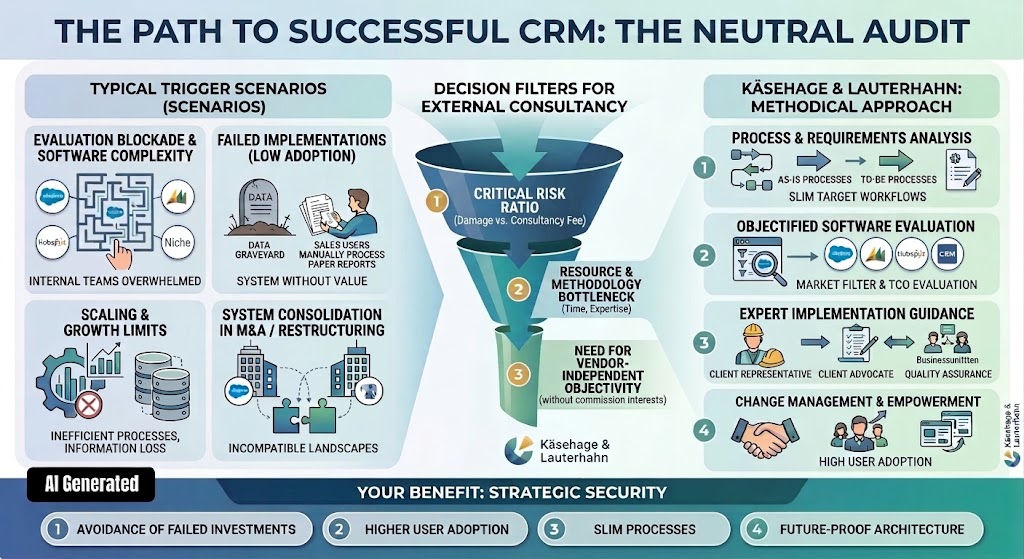
The need for external, vendor-neutral expertise manifests itself in practice in four concise scenarios:
- Evaluation Blockade and Software Complexity: Comparing established ecosystems like Salesforce, Microsoft Dynamics, or HubSpot with specialized niche providers presents significant hurdles for internal project teams. Tied system houses and software agencies naturally advise within the framework of their own product portfolio, as their business model is linked to license commissions or specific development stacks. Identifying a truly tailored solution is thus made more difficult.
- Failed Implementations and Lack of User Adoption (Low Adoption): An existing CRM system is perceived by sales only as an administrative control authority. The result: contact data is maintained incompletely, reports are manually reworked, and the system degenerates into a costly data graveyard. The discrepancy between ongoing license costs and real value contribution requires a realignment.
- Scaling and Growth Limits: Inefficient process flows, isolated data structures, and manual interfaces between marketing, sales, and service inhibit company growth. The lack of a central database leads to information loss and delayed sales cycle times as data and customer volumes increase.
- System Consolidation in the Context of M&A and Restructuring: Following corporate acquisitions or rapid department expansion, parallel, incompatible system landscapes often exist. Merging various CRM and ERP instances into a unified target architecture usually exceeds the capacities and cross-functional methodological competence of internal IT.
Decision Conditions: When the Mandate Makes Economic Sense
The use of an independent CRM consultancy requires certain strategic and organizational prerequisites on the company side:
- Critical Ratio of Misinvestment Risk to Consulting Investment: Commissioning is economically necessary when the potential damage of a wrong decision – consisting of incorrect licenses, delayed go-lives, faulty implementation, and lost sales revenue – exceeds the fee for neutral process and selection consulting many times over.
- Resource and Methodology Bottleneck: Neither the executive board nor the sales or IT management have the time capacities or methodological experience to define requirement profiles (RFPs), objectively weight vendor inquiries, and robustly audit software pitches alongside their day-to-day business.
- Need for Vendor-Independent Objectivity: The company management needs a neutral authority without sales interests for software licenses. The goal is an architecture decision based solely on individual business processes, integration requirements, and long-term Total Cost of Ownership (TCO).
How Käsehage & Lauterhahn Minimizes Risks and Secures Value Creation
Käsehage & Lauterhahn CRM Consulting acts as a vendor-independent partner at the interfaces between corporate management, specialist departments, and software providers. The service portfolio addresses the aforementioned trigger and decision conditions through a methodically structured approach:
- Process and Requirements Analysis: Before selecting software, there is a detailed assessment of the current processes and the definition of lean target processes. This forms the basis for a practical requirements specification, which forms the foundation for the entire further selection process.
- Objective Software Evaluation: Based on profound market knowledge, Käsehage & Lauterhahn filters the vendor market. By transparently comparing functionalities, license models, and implementation costs, decision-makers receive a well-founded basis for evaluation, free from commission interests.
- Technical Support for Implementation: During the implementation phase, the consultancy takes on the role of a qualified client representative. It translates between the specialist departments and the service provider's developers and ensures compliance with time, budget, and specification frameworks.
- Change Management and Enablement: To ensure high user adoption, teams are involved in the change process right from the start. Targeted training and communication concepts firmly anchor the new systems in daily work routines.
Conclusion: Strategic Certainty Instead of Software Experiments
Selecting and realigning a CRM system is a business-critical decision that extends far beyond pure IT matters. Relying exclusively on vendor-dependent recommendations in a complex software market risks costly misinvestments, inefficient processes, and low user adoption. A neutral CRM audit by independent experts such as Käsehage & Lauterhahn acts as an essential strategic safeguard. It protects against wrong decisions, relieves internal resources, and ensures that the chosen technology aligns precisely with business processes – rather than the other way around. In this way, the CRM system is transformed from a mere cost factor into a sustainable value driver for the entire enterprise.
Avoid misinvestments and unlock your full potential: Let us evaluate whether your CRM system effectively supports your growth processes or ties up valuable resources in day-to-day operations.
Book your vendor-neutral initial consultation with the specialists at Käsehage & Lauterhahn today.
FAQ: How a Neutral CRM Audit Benefits Your Business
What characterises an independent CRM consultancy?
An independent CRM consultancy operates completely free from licence commissions, fixed vendor partnerships, or specific development stacks. It focuses exclusively on requirements analysis, business processes, and the client’s long-term Total Cost of Ownership (TCO). Rather than selling standard products from a specific vendor, it objectively identifies the most suitable software solution on the market.
Why is vendor independence so important when selecting a CRM?
System integrators and vendor-tied software agencies naturally advise within the scope of their own product portfolios, as their business model is linked to selling software licences. A consultancy that operates independently protects companies from this conflict of interest. It ensures that the new system flexibly adapts to the company’s processes – rather than forcing the organisation to bend its workflows to fit the software.
When is a neutral CRM audit worthwhile for companies?
A neutral CRM audit proves strategically valuable in four core scenarios. It provides crucial orientation during evaluation bottlenecks, when internal teams stall in an overwhelming software market trying to choose between major players like Salesforce or Microsoft Dynamics and specialised niche solutions. Furthermore, it counters low user adoption when the sales team perceives the CRM merely as an administrative monitoring tool, causing it to degrade into a costly data graveyard. An audit also addresses organisational scaling limits by resolving isolated data silos and inefficient manual interfaces that stifle business growth. Finally, an independent evaluation provides the necessary foundation during M&A activities and restructurings, when incompatible CRM and ERP systems must be seamlessly consolidated following corporate acquisitions.
How does an independent CRM consultancy differ from a CRM system integrator?
A CRM system integrator acts as both contractor and reseller: its business relies on selling, implementing, and maintaining specific software brands. An independent CRM consultancy, by contrast, does not sell licences. It acts as an objective advisor and represents the client’s interests as a qualified representative vis-à-vis vendors and service providers.
How does a vendor-neutral CRM audit work?
A structured CRM audit consists of four consecutive phases. It begins with a thorough process and requirements analysis, detailing current workflows and establishing streamlined target processes within a practical requirements specification. This is followed by an objective software evaluation that compares the vendor market in a vendor-neutral manner regarding functionalities, licensing models, and implementation costs. During the subsequent expert implementation support, the consultancy acts as a qualified representative on behalf of the client to manage timelines and budgets across vendor pitches and the implementation itself. Finally, targeted change management ensures sustainable adoption by engaging all stakeholders early on and firmly embedding the new workflows into daily operations.
How does an independent CRM consultancy help with low user adoption?
Low adoption usually occurs when systems are built without involving the sales team. An independent consultancy neutrally analyses the root causes of low usage, identifies barriers, and optimises workflows so that the CRM is perceived as a genuine sales tool and a day-to-day asset. Targeted training and communication concepts ensure that the system is adopted sustainably.
When does investing in an independent CRM consultancy pay off financially?
Commissioning an independent CRM consultancy is commercially justified when the financial risk of a bad decision significantly exceeds the consulting fee. A failed investment consists not only of unused licence fees, but also delayed go-lives, faulty implementations, tied-up internal resources, and lost sales revenue. Neutral consulting safeguards the project and prevents expensive misinvestments.
About the author:
Frank Lauterhahn
Managing Partner

Frank Lauterhahn is an experienced CRM consultant who helps companies of all sizes and from all industries to develop effective CRM strategies and benefit from CRM software in the long term.
With a holistic approach, he supports his customers from the definition of objectives to business analysis and implementation.
As an independent consultant with extensive market knowledge and negotiation skills, he ensures the selection of the most suitable software solution and a smooth implementation.
Thanks to his many years of experience as a project manager in CRM technology implementation, he ensures that the project runs smoothly.
With expertise in various project methods and consulting services for the digitalization of customer management, he supports companies that are ready to exploit their full potential.