Generative AI in CRM: A Passing Trend or Real Productivity Booster?
Every day, CRM software vendors promise the moon: generative AI is supposed to revolutionize sales, automate support, and double revenue along the way. But what is left once you strip away the marketing hype and pay for expensive add-on licenses? We take a closer look at the three biggest myths surrounding GenAI in CRM systems.
Management Summary: Cost-Effectiveness and Use Cases of GenAI in CRM
An overview of the core components of a profitable AI deployment.
- Dependence on Data Quality: Generative AI does not automatically clean up existing databases. Incomplete or outdated data leads to flawed AI analyses and results. A consistent data foundation remains an absolute prerequisite for AI success.
- Focus on Efficiency in Preparation: In practice, fully automated sales emails often lack individuality and can jeopardize customer retention. The measurable value-add lever lies in the automated research, analysis, and synthesis of complex customer and market information to prepare for meetings.
- Process Optimization Through Structuring: The most significant time savings in day-to-day sales are achieved by transforming unstructured data. GenAI is capable of efficiently analyzing free text, meeting notes, or audio dictations and translating them directly into standardized CRM data fields and follow-up tasks.
- Needs-Based Licensing Instead of Blanket Solutions: Equipping the entire workforce indiscriminately with paid add-on AI licenses reduces the project's return on investment (ROI). Licensing should be role-based and strictly tied to specific procedural bottlenecks.
Will AI Soon Replace Your Sales Team? A Practical Reality Check
Reading through the feature lists of major CRM vendors today, one might think that salaried sales representatives will soon be obsolete. Artificial intelligence writes emails, forecasts deals, and maintains data. As an independent CRM consultancy, however, we often see a different picture in practice: disillusionment at the management level and AI features that are simply ignored by employees.
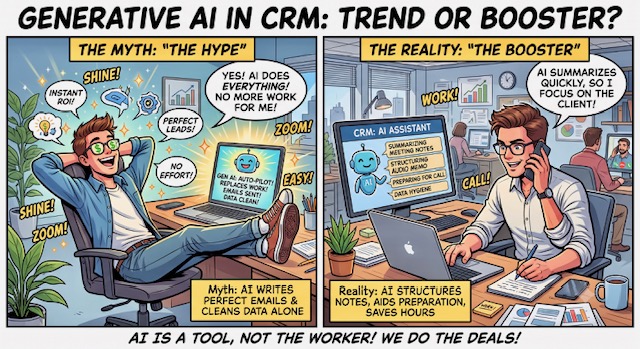
Myth 1: AI writes the perfect sales emails, saving the team 80% of their time.
One click, and the AI generates a tailored, highly personalized prospecting email for your dream client. The salesperson just has to hit "Send."
The Reality: Yes, the AI writes the email in seconds. But if everyone does this, clients will receive dozens of emails every day, all featuring the same, unmistakable "AI sound": interchangeable cliches and artificial enthusiasm lacking any personal touch. Sending these emails without review burns valuable leads.
The real productivity booster: Do not use GenAI as an autopilot for the final text, but rather as a sparring partner during preparation. Let the AI summarize long customer reports, meeting minutes, or LinkedIn profiles—for example: "Identify the three most important business challenges for this customer from their latest quarterly report." This saves hours of research. Writing the actual email remains a manual task—because business relationships are still built between people.
Myth 2: GenAI resolves our CRM data chaos at the push of a button.
Years of neglected data maintenance, duplicates, and incomplete accounts? No problem—generative AI simply pulls the information from the web and cleans up the CRM all by itself.
The Reality: The fundamental law of IT still applies: Garbage in, garbage out. Generative AI is merely a statistical model. If you feed it fragmented or outdated CRM data, it begins to "hallucinate," inventing connections or drawing false conclusions.
The real productivity booster: GenAI truly excels at structuring unstructured data. Imagine a sales rep leaving a meeting, dictating an unfiltered voice memo into the CRM app during their drive, and the AI uses it to build a call report, filter out to-dos, create follow-up tasks for the back office, and map the information to the correct fields in the CRM. This is what real relief from administrative burdens looks like.
Myth 3: Every AI feature in a CRM delivers an immediate, measurable ROI.
The Myth: Vendor-specific AI add-ons (whether Salesforce Einstein, Microsoft Copilot, or HubSpot Breeze) come with steep per-user surcharges but supposedly pay for themselves instantly through efficiency gains.
The Reality: Many companies blanket-buy these expensive AI licenses for their entire sales team without checking if the features actually fit their daily routines. If the inside sales team has no use for AI-powered revenue forecasting, the add-on is a pure waste of money.
The real productivity booster: Avoid a one-size-fits-all approach. Analyze your processes beforehand: Where are your most time-consuming bottlenecks?
- Does customer service take too long to respond? Then a GenAI assistant for your knowledge base is worth it.
- Does sales take too long to generate quotes? Then AI can help draft responses to RFPs.
Only unlock licenses for user groups that have a concrete, practical use case.
The Independent Consultant's Verdict
Generative AI in CRM is definitely not just a passing trend. But it is no silver bullet either. The mistake usually happens when companies purchase the technology before they fully understand their own processes.
Do not let glitzy vendor presentations blind you. GenAI in CRM becomes a real productivity booster when it works in the background as an invisible assistant—summarizing, structuring, and preparing. Think of AI as a tool, not an employee.
From Hype to Measurable Productivity: Does GenAI Fit Your CRM Strategy?
The targeted use of Artificial Intelligence requires a precise analysis of your existing processes and data structures. As a vendor-independent CRM consultancy, we help you separate real potential from overpriced software features and protect you from bad investments.
FAQ: Generative AI in CRM Systems – A Reality Check
Which CRM vendors currently have the best integrated generative AI?
There is no single best system. Major players like Salesforce, Microsoft Dynamics, and HubSpot all offer highly advanced AI capabilities, but they prioritize entirely different areas. While one system excels at deep data analysis and forecasting, another might be stronger in automated text generation or customer service. Which system fits you best depends entirely on your specific processes. This is precisely where we provide vendor-neutral advice. What additional costs should we expect for AI features in our CRM?
What additional costs should we expect for AI features in our CRM?
Pricing models vary significantly depending on the vendor. While some basic features are already included in higher-tier standard licenses, many providers charge substantial per-user, per-month premiums for full-scale AI assistants. In addition to these recurring license fees, you need to budget for one-time costs associated with strategic setup, data preparation, and team training. A blanket, one-size-fits-all licensing approach is almost always uneconomical. What about data privacy (GDPR) when AI processes our customer data?
What about data privacy (GDPR) when AI processes our customer data?
This is the core question for European businesses. Leading CRM vendors have now established so-called Trust Layers (data protection barriers). These ensure that your sensitive corporate and customer data is not used to train public AI models, keeping data sovereignty entirely in your hands. Nevertheless, system configurations and user permissions must be precisely mapped and tailored to be GDPR-compliant during implementation.
Should we wait to adopt AI until the technology is more mature?
These systems are already operating reliably and delivering real value. Waiting around risks falling behind your competitors in terms of process efficiency. The smart approach isn’t to wait, but to take a step-by-step path: start with a clearly defined, low-risk pilot project, such as the automated creation of call reports. Scale up only after achieving your first successes.
How do we overcome employee skepticism toward the new AI?
A lack of user adoption is the most common reason CRM projects fail. The rollout of AI must be communicated as a way to lighten the workload, not as a tracking or monitoring tool. Show your team concretely how the AI relieves them of tedious administrative routine work, like data maintenance. Hands-on coaching sessions rather than theoretical lecture-style training are key here.
Why is an independent consultancy so important for the topic of KI in CRM?
Software vendors and system integrators make money by selling and implementing their respective licenses. Naturally, they will always recommend their own AI module. As an independent consultancy, we do not sell software. Our focus is solely on what makes economic sense for your business: we evaluate beforehand whether your data quality is sufficient for AI, which features will actually move the needle for you, and where you can save money on expensive add-on licenses.
About the author:
Frank Lauterhahn
Managing Partner

Frank Lauterhahn is an experienced CRM consultant who helps companies of all sizes and from all industries to develop effective CRM strategies and benefit from CRM software in the long term.
With a holistic approach, he supports his customers from the definition of objectives to business analysis and implementation.
As an independent consultant with extensive market knowledge and negotiation skills, he ensures the selection of the most suitable software solution and a smooth implementation.
Thanks to his many years of experience as a project manager in CRM technology implementation, he ensures that the project runs smoothly.
With expertise in various project methods and consulting services for the digitalization of customer management, he supports companies that are ready to exploit their full potential.