What is CRM? Definition, Benefits, and Modern Strategies for Sales, Marketing, and Service in the AI Era
In today’s modern business landscape, Customer Relationship Management (CRM) is far more than just a digital address book. It functions as the strategic heart of any organization, unifying marketing, sales, and service on a shared data foundation. This article examines CRM from a user-centric perspective, demonstrating how the integration of Artificial Intelligence (AI), ERP connectivity, and precise data analytics creates a seamless customer journey. For management, a modern CRM translates to maximum transparency in sales steering, efficient lead management, and a data-driven foundation for sustainable growth.
Introduction: CRM as the Operating System for Customer Centricity
In the past, CRM was often an unloved tool used purely for documentation, a data graveyard maintained by employees without offering them any real added value. Today, that image has radically changed. In an era of hybrid work models, complex B2B buying decisions, and a flood of digital touchpoints, CRM has become the central operating system for business success. It is no longer about whether you store data, but how you use it to anticipate customer needs, automate processes, and increase efficiency across all customer-facing departments. Those who still view CRM as isolated software are missing the potential to solidify their market position through an excellent customer experience.
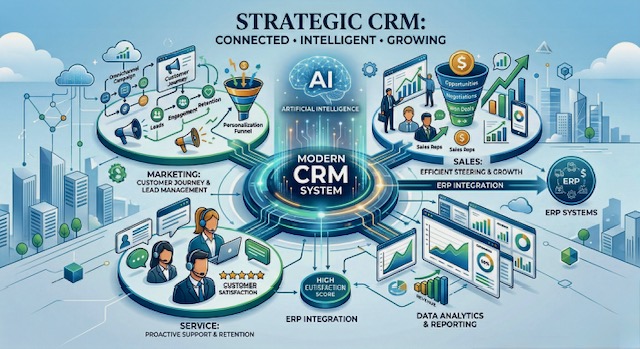
The Modern CRM Approach: Synergy Through a Shift in Perspective
1. The Marketing Perspective: From Lead Management to a Personalized Journey
For marketing teams, the CRM is the primary tool for turning anonymous website visitors into loyal customers. The focus here is on precise Lead Management. Modern systems allow leads not only to be captured but also to be evaluated according to their purchase readiness via automated Lead Scoring.
Today’s marketing teams use CRM to map the entire Customer Journey. By integrating marketing automation tools, data on clicks, downloads, and webinar participation flows directly into the CRM profile. This enables hyper-personalization: a potential customer no longer receives a standard brochure but specifically curated content that matches their previous interaction behavior. Furthermore, linking campaign data with actual sales figures in the CRM enables ROI reporting that goes far beyond "vanity metrics" like clicks. It shows exactly which campaigns contributed to the bottom line.
2. The Sales Perspective: Efficient Steering and Closing Power
In sales, time is the most valuable resource. A modern CRM acts as both a personal assistant and a strategic steering element. Sales steering is now data-driven: sales managers can see in real-time which deals are stalling in the pipeline and where support is needed.
For the individual sales representative, CRM primarily means work relief through automation. Phone calls are automatically logged, and emails are assigned directly from Outlook or Gmail via plugins. However, the true strength lies in prioritization. Instead of calling based on a "gut feeling," the system provides suggestions on which customer should be contacted next based on their behavior or history. Through mobile apps, field staff have all the information—from the last complaint to current stock levels (via ERP integration)—available directly on their tablets. The CRM thus transforms from a control instrument into a true enabler for more deals.
3. The Service Perspective: Proactive Support Instead of Reactive Help
In a modern CRM understanding, customer service is no longer a cost center, but a profit center for customer retention. Service users benefit from the "Single Source of Truth." When a customer calls, the support representative immediately sees the entire history: Which products were purchased? Were there past issues? Which marketing offers did the customer receive?
This 360-degree view enables support that doesn't have to start from scratch. Integrations with telephone systems (CTI) ensure that the customer profile appears on the screen the moment the phone rings. Furthermore, modern CRM enables proactive action. For example, if a sensor on a machine (IoT) reports an imminent defect, the CRM can automatically create a ticket and schedule a service call before the customer even notices a problem. This makes customer satisfaction predictable.
4. The Technological Vanguard: AI, ERP, and Data Analysis
The true power of a CRM unfolds through connectivity. One of the most important functions of modern systems is ERP integration. Only when master data, orders, invoices, and payment terms are synchronized between CRM and ERP does a complete picture of Customer Equity emerge. A salesperson needs to know if a customer has outstanding invoices before negotiating a discount.
Artificial Intelligence (AI) in CRM is no longer a future scenario; it is current practice:
- Predictive Sales: AI forecasts the closing probability of deals.
- Sentiment Analysis: The system recognizes the mood in customer emails and warns of potential escalations.
- Next Best Action: Algorithms suggest the next logical steps to the user.
Reporting and data analysis form the backbone for management. Modern dashboards allow for drill-downs to individual data records. Instead of waiting weeks for a monthly report, a single click is enough to check forecast accuracy or compare the conversion rates of different sales channels.
5. Strategic Growth Through Scalability
A CRM is never "finished." It grows with the requirements of the company. Modern cloud solutions offer the flexibility to add new functions or users with the click of a button. For companies, this means they can start small—perhaps with simple contact management—and successively expand the system into a comprehensive platform for Customer Experience. A professional CRM consultancy ensures that the technological architecture is chosen so that it can also map future requirements, such as international expansion or complex partner ecosystems.
Résumé: Choosing the Right Path
In summary: CRM is not a product you buy, but a discipline you master. The technological possibilities, from AI-supported analysis to seamless ERP integration, offer enormous opportunities to increase efficiency and strengthen customer loyalty. However, technology alone is only half the battle. The success of a CRM project is decided by user acceptance in marketing, sales, and service. Only if the system offers real added value in daily work and meaningfully supports processes will it become the engine for corporate growth. As an experienced CRM consultancy, we accompany you not only in finding the right software but in elevating your entire organization to a new level of customer centricity.
Theory is essential, but every project is unique. If you would like to discuss how these insights specifically apply to your business, please Contact us for a no-obligation initial consultation.
Mastering Modern CRM
Why is CRM considered an operating system rather than just software?
In the past, CRM was a static data graveyard for contact info. Today, it acts as an operating system because it dynamically connects every department—Marketing, Sales, and Service—on a single platform. It automates workflows, integrates with external tools like ERPs, and uses AI to drive real-time decision-making, making it the central engine of your business growth.
How does a modern CRM improve Lead Management in Marketing?
Modern CRMs go beyond simple data entry. They allow marketing teams to map the entire Customer Journey and implement Automated Lead Scoring. By analyzing digital touchpoints (clicks, downloads, webinar views), the system identifies high-intent leads and triggers hyper-personalized content, ensuring your sales team focuses only on prospects ready to buy.
Can a CRM actually help my sales team close deals faster?
Yes, by removing administrative friction. Through Sales Automation, activities like email tracking and call logging happen automatically, freeing up time for actual selling. Furthermore, AI-driven prioritization (Predictive Sales) tells reps which deals have the highest probability of closing, while mobile access to ERP data ensures they have every detail needed during client meetings.
What does a Single Source of Truth mean for my Customer Service?
It means that every employee sees the exact same customer profile. When a customer calls, the service agent sees their full history—past purchases, open sales opportunities, and marketing interactions. This 360-degree view eliminates the need for customers to repeat themselves, leading to faster resolutions and significantly higher retention rates.
How do AI and ERP integration transform data into a strategic advantage?
The real power lies in connectivity. Integrating your ERP with your CRM provides a full view of Customer Equity, such as order history and credit status. When you add Artificial Intelligence, the system moves from reporting the past to predicting the future, offering Next Best Action suggestions and identifying churn risks before they happen.
Why should I invest in CRM consultancy instead of just buying a license?
A CRM is a strategic discipline, not a plug-and-play product. Studies show that projects often fail due to low user acceptance or poor process mapping. A CRM consultancy ensures your technical architecture matches your business goals, optimizes your processes before they are digitized, and manages the cultural change within your team to ensure the system is actually used to drive ROI.
About the author:
Frank Lauterhahn
Managing Partner

Frank Lauterhahn is an experienced CRM consultant who helps companies of all sizes and from all industries to develop effective CRM strategies and benefit from CRM software in the long term.
With a holistic approach, he supports his customers from the definition of objectives to business analysis and implementation.
As an independent consultant with extensive market knowledge and negotiation skills, he ensures the selection of the most suitable software solution and a smooth implementation.
Thanks to his many years of experience as a project manager in CRM technology implementation, he ensures that the project runs smoothly.
With expertise in various project methods and consulting services for the digitalization of customer management, he supports companies that are ready to exploit their full potential.